
Call Today: 1-800-890-2262

What Does October 2025 Government Shutdown Mean for Social Security?

As all of you are undoubtedly aware, the federal government shut down on October 1, 2025 because Congress and the President could not come to an agreement regarding funding to keep the government open. The early indication is that this may last for some time. Understandably, this creates concern for our clients. Below is the best information available right now about how this might affect clients who are in the process of applying for benefits.

Benefits to Current Claimants

Clients already receiving Social Security, SSI, or SSDI benefits will continue receiving payments without interruption. This has been true in all 20 previous shutdowns since 1976, and disability benefits remain funded as “mandatory spending” outside of congressional appropriations.

Pending Claims and Applications

Hearings: The Social Security Administration (SSA) will hold already scheduled disability hearings.

Initial Applications: State Disability Determination Services will continue processing initial claims, but processing speed may vary because each state controls its own staffing and funding during a lapse. Each state must independently determine whether it can maintain operations (pay its employees) during a federal funding lapse. This could lead to some states processing claims more or less as usual, but others, more affected by the funding lapse, may be processing claims more slowly.

Appeals/Reconsiderations: These will continue but probably with reduced support staff, resulting in extended processing times. Continue reading →

Winning Social Security Disability Claims for Lyme Disease: What Works for Me

Lyme Disease and Social Security disabilityAs a Social Security disability attorney, Lyme disease cases represent a complex, frustrating, and often misunderstood type of disabling chronic illness. While the acute phase of Lyme disease is widely recognized and typically responsive to antibiotics, a subset of individuals develop long-lasting symptoms—often referred to as “chronic Lyme disease” or “Post-Treatment Lyme Disease Syndrome” (PTLDS). These cases are challenging both medically and legally, particularly when pursuing Social Security Disability Insurance (SSDI) or Supplemental Security Income (SSI) benefits.

In this blog post I will discuss winning strategies that I have used over the past few years to develop a compelling case for benefits based on Lyme disease.

Lyme Disease – the Basics

Lyme disease is caused by a bacteria called Borrelia burgdorferi, transmitted by ticks. While early-stage Lyme disease is well understood, PTLDS is still gaining wider medical acceptance. A recent Johns Hopkins study found that 14% of early-diagnosed patients developed prolonged symptoms such as fatigue, musculoskeletal pain, and neurocognitive impairment. More recently the Wall Street Journal published an article entitled “Chronic Lyme Disease Acceptance Grows Among Doctors After Years of Debate.”

Interestingly, the aftermath of COVID-19 has offered the public and medical professionals a clearer picture of how infectious diseases can lead to persistent, debilitating post-viral syndromes. I believe that this context helps Social Security judges understand chronic Lyme within the broader framework of post-infectious disability syndromes. Continue reading →

Why Your Long Term Disability Insurance Company Can Demand That You Turn Over Your Social Security Disability Lump Sum Payment

If you are receiving long term disability benefits, you can be certain that your LTD carrier will require you to file for Social Security disability. What is the practical effect of pursuing Social Security disability and how should you handle the insurance company’s request.

Most of the LTD policies I see are company provided. These company sponsored policies are sometimes called “ERISA policies” because the rules that govern how they are administered are set out in a federal law called the Employee Retirement Income Security Act of 1974 (ERISA).

If you worked for a company that gave you the option of purchasing short term and long term insurance as a payroll deduction, you almost certainly have an ERISA policy.

Under the terms of your ERISA policy you are required to apply for Social Security disability if your LTD claim is approved. Why? Because the insurance company has the right to offset what it pays you by what you receive from Social Security.

Here is an example – let’s say that your LTD policy pays you $2,500 per month if you meet the insurance company’s definition of disability. If your Social Security disability benefit is $2,000 per month, then the insurance company will reduce what it pays you to $500 per month since SSA is paying $2,000.

Your monthly payment remains at $2,500 per month but it will come from two sources instead of one. Continue reading →

June 2024 Change in Past Work Look Back Benefits Claimants

The Social Security Administration has made a significant change in disability claim evaluation by reducing the number of years it will look at your past work.

As of June 24, 2024, SSA will only consider the work you have performed during the past 5 years as “relevant.” Up until this point, SSA looked at your work history over the past 15 years.

This change will benefit disability claimants because it will be more difficult for SSA to argue that you have the skills or capacity to perform past work. This change reflects the reality that (1) jobs in just about every sector of the economy have changed significantly over the past 15 years; and (2) it reflects the reality that the Dictionary of Occupational Titles (the D.O.T. is a resource that described jobs in the U.S. economy but was last updated 40 years ago but still used by vocational experts at hearings) does not accurately describe most jobs.

In cases where the Grid Rules apply (claimants over age 50 with physical limitations), the new 5 year rule will reduce the likelihood that the vocational expert can identify transferable skills. In the absence of transferrable skills, the more likely that you will be found disabled under a grid rule.

In a broader sense, this change to the “past relevant work” look back makes sense. Most jobs have changed significantly over the past 15 years. Continue reading →

Mental Health Disability Claims: Do You Have a Winning Case?

mental health disabilityI have written about this issue before but, given the stress of the coronavirus pandemic, I think this question deserves another look because just about every case evaluation I see contains allegations of some mental health concern.

I suspect we will be dealing with the repercussions of Covid-19 for years. In Atlanta, where I live, it seems that every night we see news stories of road rage shootings and other violent crimes.

Entire sectors of the economy have been devastated, causing upheavals in the job markets. How many restaurants have closed over the past year? How many men and women in the hospitality, tourism or travel industries are out of work? And for those who remained employed, many had to adjust to working from home while balancing child care and school-from-home obligations.

It is certainly no wonder that daily stress – whether financial, interpersonal or otherwise – has resulted in more cases of clinical depression and anxiety disorders. Hardworking men and women who might have been struggling with depression or social anxiety but was “getting by” now find the pressure of adapting to a post-pandemic world simply too much.

Here is some of what I see from potential clients in case evaluation requests:

“I cannot physically, mentally and at times emotionally work more than a few hours a week. I have noise intolerance with voices, music, and sounds, especially higher pitches. I have to wear noise cancelling ear phones and they don’t fully help. I cry at times from overstimulation which could be even from thinking, planning or riding in a vehicle. I cannot drive.”

“I have severe depression and anxiety and I can no longer focus on my work. And I had suicidal thoughts I am writing this right now it is 4:35 in the morning. I don’t sleep and I am taking antidepressants like mirtazapine 45 mg and am always sleepy and tired.” Continue reading →

“I’m 34 Years Old with Serious Medical Problems but Still Hanging on at Work. Should I Quit and File for Social Security Disability?”

should I file for disabilityAs a Social Security disability attorney, I frequently receive emails like pose this question – from a man or woman in their 30’s or early 40’s with a long standing medical condition that makes work a real struggle.

Sometimes the issue is chronic pain – in the back, the knees or even a generalized body pain (like fibromyalgia). Sometimes the underlying medical condition is a chronic disease like diabetes or kidney disease that saps one’s energy and makes it difficult to function reliably day after day.

I even hear from potential clients who are cancer survivors – the cancer may have been removed surgically but the struggles with long term effects of chemotherapy or radiation remain.

More recently I am hearing from Covid “long haulers” – people who contracted Covid in 2020 and who continue to struggle with cognitive loss, low energy and occasional breathing issues.

And almost every younger person I correspond with has some level of anxiety or depression about how facing a future with likely lifelong medical complications, and stress about how they will support themselves or their families.

Should You Quit Work to File for Disability?

So, if you find yourself in one of these situations, what should you do? Keep working? Quit and file for disability? Work part time and file for disability? Here are my thoughts about the reality of pursuing disability if you are under 50 and still hanging on at work. Continue reading →

Are Social Security Judges Denying Disability Claims by Relying on Bogus Data?

why disability judges deny claimsRecently a television station in Charlotte, North Carolina ran a story about the Social Security disability decision making process called “Obsolete Jobs” Prevent People from Receiving Disability Payments (click on link to view story).  The story recounted the struggles of a Charlotte man who with a severe and painful back injury who was denied at his disability hearing by a judge who concluded that he has the capacity to perform a variety of non physically demanding jobs that exist in the economy.

Since the underlying question in every disability hearing asks whether the claimant has the capacity to perform even a simple, entry-level job, judges rely on vocational expert witnesses to identify jobs that a “hypothetical person” with the same impairments as the claimant could perform. Continue reading →

Disability Approval Rates Trending Up

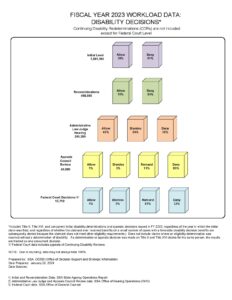
Social Security recently released its annual “waterfall chart” showing approval and denial rates for disability claims at various stages in the disability application process.

As you can see, SSA approved 39% of applications filed without requiring any appeals at all.  This means that 39% of disability applications applied and were approved within 3 to 4 months.

For those ending up at hearings, SSA judges approved 49% of all claims.  This is up significantly from the 43% and 44% we saw just a few years ago.  The trend is certainly favorable over the past few years – hopefully, for the sake of deserving claimants, this continues.

You may find the idea of labeling yourself as  “disabled” troubling and this is understandable.  But if you cannot work anymore because of a chronic and severe medical problem, you very well may meet SSA’s definition of disability.  If our office can be of help to you in navigating these confusing waters please let us know.

Do You Really Need a Suicide Attempt or Inpatient Psych Hospitalization to Win Your Depression Disability Claim?

If you are pursuing Social Security disability benefits and your primary impairment is depression, you will need more and stronger evidence to win your case.

Over the past few years I have noticed a trend in my law practice whereby judges are less likely to award benefits in depression cases unless your medical record contains evidence of suicide attempts, in-patient psychiatric hospitalizations or other symptoms that could be life threatening.

Unlike medical conditions like back pain arising from a herniated disc, irritable bowel syndrome associated with a diseased colon, cancer that requires surgery, radiation and chemotherapy, or blood clots that require you to keep your legs elevated, severe depression cannot be imaged using an MRI, CT scan or ultrasound. Psychologists and psychiatrists test for depression based on conversations with patients and their long term relationships with their patients. Continue reading →

Top